English (Speaker A): "Hey, I just wanted to say—that was a remarkably brave presentation. Calling the industry's favorite new software 'a glorified spreadsheet with a budget' took some serious guts, especially with their CEO sitting in the front row."
Russian (Speaker B): "Ой, а я и не заметил, что он там сидел! Хотя, честно говоря, мне всё равно. Кто-то же должен был сказать, что король-то голый. Я Макс, кстати. Тот самый безумец, который только что уничтожил свою карьеру за пятнадцать минут."
English (Speaker A): "I’m Elena. And don't worry, your career is fine. If anything, you just became the most interesting person in this room full of corporate clones. Your point about data privacy was actually spot on, even if it made the sponsors sweat."
Russian (Speaker B): "Приятно познакомиться, Елена. Спасибо, это обнадеживает. Я просто жутко устал от того, что на этих конференциях все ведут себя так, будто мы спасаем мир, хотя мы просто продаем людям очередные подписки. Ты, судя по всему, тоже не фанатка фальшивых улыбок?"
English (Speaker A): "Guilty as charged. I head a UX research team, and my entire job is to figure out why users hate platforms like the one you just roasted. In fact, I’ve been trying to convince my stakeholders to dump that software for months. You just gave me some great ammunition."
Russian (Speaker B): "Рад служить обществу! Слушай, если ты занимаешься UX, то ты наверняка понимаешь мою боль. Они тратят миллионы на маркетинг, но интерфейс выглядит так, будто его создавал обозленный подросток в 2005 году. Как твоя команда вообще с этим справляется?"
English (Speaker A): "With a lot of coffee and a healthy dose of dark humor. Look, a few of us are skipping the remaining afternoon panels to grab a proper lunch and actually talk real strategy. We could use someone with your lack of a filter. Want to tag along?"
Russian (Speaker B): "Звучит как идеальный побег из этого цирка. Я только «за». Только чур никакого фастфуда — после такого стресса мне нужно что-то посущественнее. Веди меня к бунтарям!"
English (Speaker A): "Deal. Let’s head out before the PR team tracks you down for damage control. Drop your phone number or scan my LinkedIn on the way to the elevator—we’re moving fast."
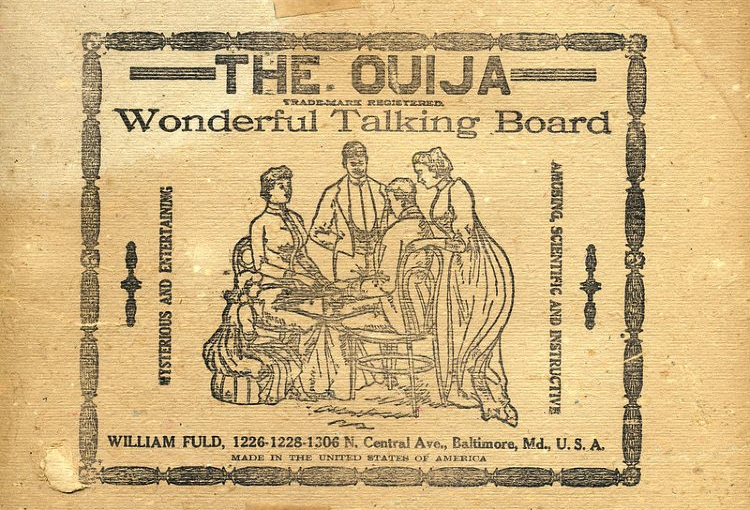
In February 1891, advertisements began circulating in North America for ‘Ouija, the Wonderful Talking Board’. It promised to answer questions about ‘the past, present and future’ by providing a link ‘between the known and unknown, the material and immaterial.’
The spiritualism craze was well and truly underway by the late 19th century, and the Ouija board emerged as one of the most famous items associated with the paranormal.
Feared by some and mocked by others, the Ouija board has a fascinating history and is still used and celebrated by its cult following to this day.
A timely invention

The original Ouija board design, created around 1890.
Image Credit: Wikimedia Commons / Museum of Talking Boards
1111111111
The first patented talking board
The emergence of an ‘automatic writing’ form of spiritualism, whereby words are seemingly created by an external force, was not new. The first mention of fuji or ‘planchette writing’ dates to around 1100 AD in historical documents from the Song Dynasty in China. Before the formal invention of the Ouija board, the use of talking boards was so common that by 1886 the news reported the phenomenon taking over spiritualist camps in Ohio.
In 1890, Elijah Bond, a local attorney and entrepreneur in Baltimore, Maryland, decided to capitalise upon the craze, and so he formalised and patented a commercial talking board. The result was a board marked with the letters of the alphabet, as well as the numbers 0-9 and the words ‘yes’, ‘no’ and ‘good bye’. It also came with a small heart-shaped planchette which was used in seances whenever a spirit wanted to write a message on the board.
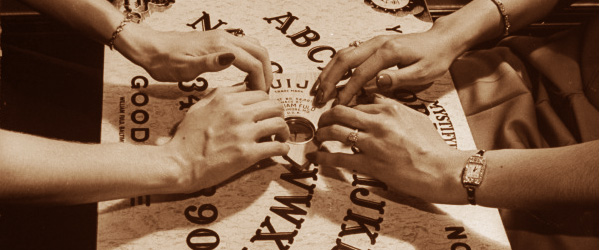
To use a Ouija board, a group of people gathers around a table with the board upon it, and each person places their fingers on the planchette. It is then possible to ask questions of the spirit, with the planchette moving to the letters, numbers or words to formulate a response. The board’s design and method remain the same to this day.

A halloween party featuring a Ouija board.
Image Credit: Flikr / simpleinsomnia
Parts of the Ouija board origin story have been debated. For instance, the word ‘ouija’ itself has been reported as being an ancient Egyptian word for ‘good luck’, while a contemporary etymological explanation is that the word is a combination of the French and German for ‘yes’.
However, it is more likely that it comes from Helen Peters, sister of Elijah Bond who reportedly had spiritual powers and was wearing a locket featuring the name ‘Ouija’ while sitting in the patent office.
Skyrocketing popularity
The Kennard Novelty Company began manufacturing Bond’s patented Ouija boards en masse. They became instant money makers. By 1892, the company added another factory in Baltimore, then founded two in New York, two in Chicago and one in London. Marketed somewhere between mystical oracle and family parlour game, some 2,000 Ouija boards were being sold a week.
Over the coming century, the board experienced spikes in popularity during periods of uncertainty. The devastation of World War One and the manic years of the Jazz Age and prohibition prompted a surge in Ouija board purchases, as did the Great Depression.
Over five months in 1944, a single department store in New York sold 50,000 boards. In 1967, which coincided with more American troops being sent to Vietnam, the counter-culture Summer of Love in San Francisco, and race riots in Newark, Detroit, Minneapolis and Milwaukee, over 2 million boards were sold, outselling Monopoly.
1. According to the text, why did spiritualism become so popular in North America during the late 19th century?
A) It was heavily promoted by President Lincoln.
B) People were grieving losses from the Civil War and dealing with high mortality rates.
C) The concept was entirely new and intrigued the public.
D) European spiritualists moved en masse to the United States.
2. What does the text state about the origin of "automatic writing" devices?
A) They were invented by Elijah Bond in 1890.
B) The idea originated in Europe before moving to Ohio.
C) Similar concepts date back hundreds of years to China.
D) They were initially designed exclusively as children's parlor games.
3. The word "Ouija" most likely originated from:
A) A combination of European words meaning "yes."
B) An ancient Egyptian phrase for good fortune.
C) The name of a manufacturing company in Baltimore.
D) A piece of jewelry worn by the inventor's sister.
4. What pattern did Ouija board sales follow throughout the 20th century?
A) Sales steadily declined as public interest in the paranormal faded.
B) Demand consistently peaked during times of social, economic, or political distress.
C) They were only popular during the Halloween season each year.
D) Sales remained stagnant until they suddenly outsold Monopoly in 1967.
Part 2: Vocabulary in Context
Find the words in the text that match the following meanings. The paragraph headings are provided to help you.
____________ (Noun, A timely invention): A temporary fashion, notion, or intense public enthusiasm.
____________ (Verb, The first patented talking board): To take advantage of something or use a situation to make money or gain an advantage.
____________ (Noun, Skyrocketing popularity): Rapid and dramatic increases in value, numbers, or popularity.
Part 3: Language in Use (Word Formation)
Complete the sentences below by changing the form of the word in BOLD so that it fits grammatically into the context of the history of the Ouija board.
In the late 1800s, many viewed communicating with spirits as a HARM ____________ parlor game rather than something sinister.
The Kennard Novelty Company found immediate COMMERCE ____________ success when they began producing the boards en masse.
The board's history is incredibly FASCINATE ____________, reflecting the changing anxieties of the eras it passed through.


Комментариев нет:
Отправить комментарий