https://www.englishrevealed.co.uk/CAE/Part1/cae_multiple_choice_cloze_1.php


News media is often biased.
⇒ News media biased. (tends)
2Most unqualified people are on low incomes.
⇒ unqualified people are on low incomes. (majority)
3A university education is expensive, so many young people have large debts.
⇒ A university education is expensive. , many young people have large debts. (result)
4People with a university education often have large debts. However, they tend to earn more.
⇒ People with a university education often have large debts. , they tend to earn more. (hand)
5In my opinion, exams are not the only way to measure a student's ability.
⇒ , exams are not the only way to measure a student's ability. (mind)
6In conclusion, electric scooters offer a convenient and eco-friendly mode of transportation, particularly in busy urban areas.
⇒ , electric scooters offer a convenient and eco-friendly mode of transportation, particularly in busy urban areas. (sum)
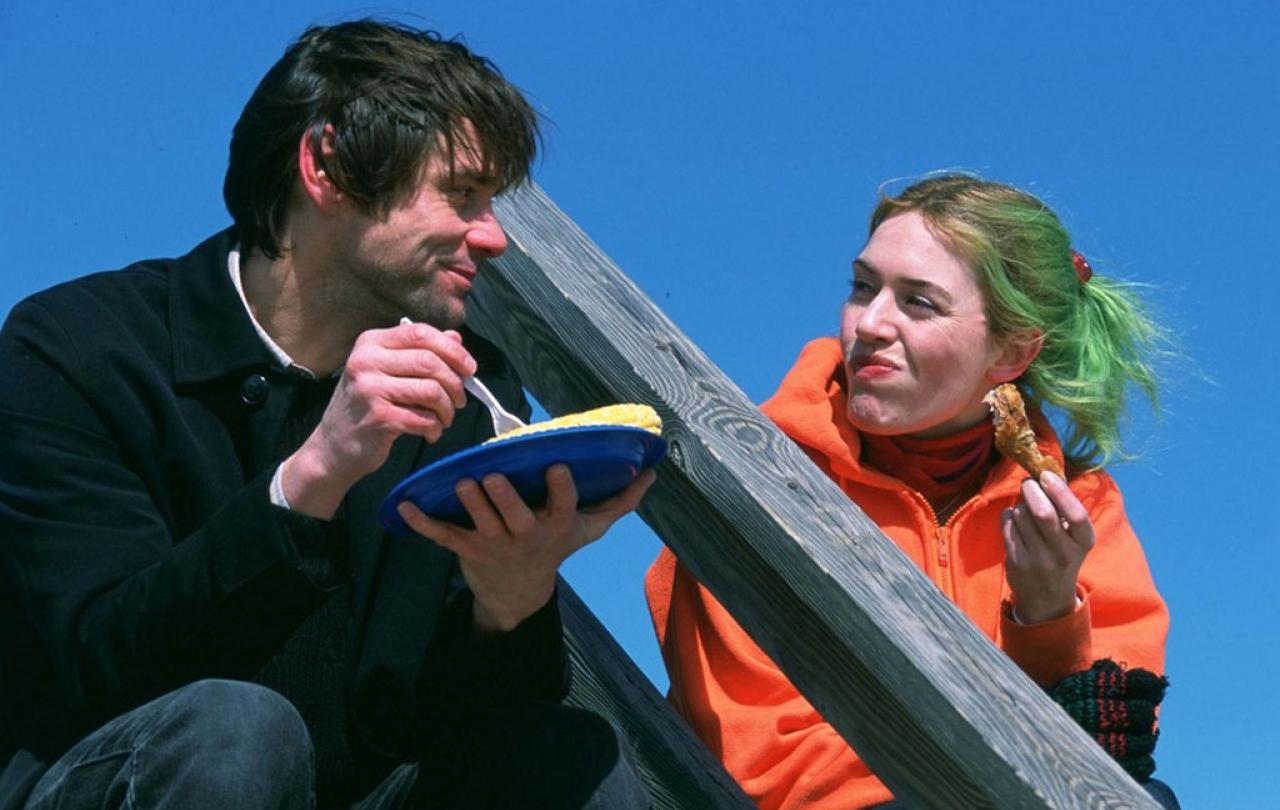
Michel Gondry’s Eternal Sunshine of the Spotless Mind came out in 2004. Twenty years on, its stubborn insistence that the memory of pain gives meaning to our lives is as relevant as ever.
I first watched Gondry’s cult classic earlier this year, in the midst of recovering from postnatal PTSD. When we are faced with heartbreak, it can be easy to wish that we could retreat from painful memories, hiding them away until the initial pang has seemingly died down. That was my experience, at least. But I quickly learnt that the traumatic memory of my daughter’s birth would continue to resurface until I processed it and accepted it as part of my life. Just so, Eternal Sunshine of the Spotless Mind teaches us that being vulnerable to suffering is a gift, that suffering itself is necessary to our moral growth, and that our ability to remember the past is an invaluable faculty of the human mind.
The film begins simply, with a meeting between its protagonists, Joel Barish and Clementine Kruczynski. As Joel and Clementine start making small talk, they seem immediately comfortable, almost familiar with each other, and yet the atmosphere is eerie. Soon enough, we discover that Clementine was a patient at Lacuna, a clinic which erased every memory of Joel from her mind after their two-year relationship ended in a painful breakup. When Joel finds out, he asks Dr. Howard Mierzwiak, the director of Lacuna, to do the same for him. As viewers, we now start to wonder: was that meeting we witnessed their very first, or have they met again after their memories were erased, unaware that they loved each other in a ‘past’ life?
This tone of disorientation continues throughout the film, and that’s what makes it so special. As Joel’s memories of Clementine are erased one by one, he realises that the removal of one’s painful experiences is in itself a kind of trauma; what promises to be a relief, turns out to be nothing more than loss.
We experience this sense of disorientation and loss alongside Joel as we jump through snippets of his and Clementine’s happiest and saddest moments together, trying to piece together in our minds a linear narrative of their relationship. While this is happening, the film’s subplot focuses on Stan, Patrick, and Mary, three young people working for Lacuna. As Stan and Patrick, the ‘technicians’, work on Joel’s memory removal, Mary, Lacuna’s naive receptionist, muses on the beauty of their mission.
Mary has an idealistic vision of her work: she believes she is helping suffering people experience the kind of ‘eternal sunshine’ that only a ‘spotless mind’ can achieve. But the human mind is not so simple. Joel’s desire for forgetfulness quickly turns nightmarish. As he realises he has made a mistake, he starts fighting to retain the memory of his love for Clementine, but his is a hopeless quest. Dr. Mierzwiak’s intervention ensures that the procedure is completed.
Left alone without Stan and Patrick, Mary confesses to the married Dr. Mierzwiak that she is in love with him. It is at this point that her idealism crumbles down. He reveals that they’ve already had an affair in the past and that she agreed to let him erase its memory from her mind. Mary is devastated. She decides that what Lacuna is doing is unethical - even if Mierzwiak technically has the patients’ consent to the procedure - and releases the clinic’s files back to the patients. It is this decision which leads Clementine and Joel, just a few days after they ‘meet’ again, to discover that they’ve already loved each other in the past.
Although the script of the film doesn’t spell it out, Mary’s story emphasises that the absence of painful memories is in itself experienced as a painful loss. What’s more, it shows that, without the memory of the suffering which we have inflicted on others, and which others have inflicted on us, we are incapable of moral growth. Thanks to the knowledge of the past, Mary is able, this time around, to resist having an affair with a married man. Just so, the final scene of the film, which sees Joel and Clementine vow to renew their relationship, is hopeful not in spite of the fact that they have regained the memory of the ways in which they hurt each other in the past, but precisely because of it.
Accepting suffering and holding it in our hearts, not with bitterness, but rather with courage, requires endless patience and infinite hope. But that is what we were made for. Each one of us is called to endure pain in imitation of Christ, and, out of that pain, to discover a greater capacity for sacrificial love. We make meaning out of pain: that’s what human beings do.
Why does the narrator relate their experience of postnatal PTSD to the message of the film?
How does the film portray the act of erasing memories — as relief or as another form of trauma? Explain.
What role does Mary play in the moral message of the story?
In the end, why is Joel and Clementine’s decision to restart their relationship considered hopeful?
Match the highlighted words/phrases from the text to their meanings.
A) "stubborn insistence"
B) "moral growth"
C) "muses on"
D) "idealistic vision"
E) "to hold it in our hearts"
To think deeply or reflect about something
Personal development based on ethical learning from past mistakes
A fixed, determined demand or emphasis
Keeping a feeling or experience as part of one’s emotional memory
A way of seeing things that is overly optimistic or detached from reality
The author writes: “The absence of painful memories is in itself experienced as a painful loss.”
Do you agree or disagree? Give one real-life or fictional example to justify your answer.
Based on the text, what does the author suggest about the relationship between memory, suffering, and identity? Choose the best summary:
A) Painful memories should be erased to allow personal freedom.
B) Suffering is meaningless, but memories help us cope with it.
C) Pain and memory are both essential to building a meaningful, morally mature identity.
D) Forgetting suffering is harmless as long as one can start over.


https://test-english.com/writing/b1-b2/writing-a-how-to-article-for-a-blog-or-magazine/
Write a “How-to” article (about 200–250 words) for a blog or magazine.
Choose one of these topics (or make up your own):
How to adapt quickly when you move to a new country.
How to make friends when you don’t speak the language fluently.
How to feel at home in Italy when you are far away from Ukraine.
How to deal with culture shock in a positive way.
How to balance two cultures: keeping your traditions and learning new ones.
How to learn Italian faster while living in Italy.
https://www.instagram.com/p/DJr3SjONtEJ/
Welcome to the Grand Horizon Hotel, a place where every detail is designed to make your stay unforgettable.
As soon as you arrive, our ______ staff will greet you with warmth and kindness, making you feel at home from the very first moment.
The hotel is located on a hill with a ______ view of the ocean — a scene you will never forget.
In our restaurant, you can taste ______ dishes prepared by award-winning chefs, offering both local and international cuisine.
Our room service is ______, ensuring that your requests are handled quickly and efficiently at any time of the day.
Each suite is decorated with ______ elegance, combining comfort and modern design without a single detail out of place.
In the evenings, guests can enjoy ______ entertainment programs, from live music to cultural performances, that will keep you engaged and delighted.
https://test-english.com/reading/b2/why-are-so-many-men-secret-dieters/


Cryptocurrency trading has become very popular. By buying and selling different currencies, traders can make huge profits. However, trading addiction is becoming increasingly common. Here, addict Josh Johnson talks about his experience.
‘I heard about cryptocurrencies years ago when Bitcoin first came out, but I can’t say I was intrigued from the start. Even when cryptocurrencies were mentioned more and more in the news and on social media, I didn’t pay much attention. It wasn’t until my friends started trading that I got into it. Seeing them earning loads of money overnight by doing practically nothing made me want to get in on it too. I’d been trading for a while by the time the pandemic started, but that was when the trouble started.
‘It was crazy to begin with. My first investment quadrupled within a couple of weeks. I couldn’t believe it. It gave me a feeling of power, and I felt as if I could achieve anything. I poured more money in, and the same thing kept happening. Of course, it was all chance. I happened to put my money in before the currencies hit an all-time high. Then they plummeted. I was convinced they’d recover, so I kept pumping more money in. But what had worked before no longer did. I lost everything.
‘Since getting help, I’ve thought about how I got addicted. There was a point when I had over three hundred thousand pounds. If I’d quit then, I could have bought the house that I had my heart set on. But rather than the money itself, it was the drama that hooked me. And winning didn’t give me as big a thrill as losing. You would think I’d feel devastated when money disappeared, but instead, I’d feel a new sense of purpose and drive to prove myself once again.
‘Lots of people enjoy these highs and lows of trading without becoming addicts, so it’s hard to know when you’ve gone too far. Like with many addictions, crypto addicts become isolated and withdrawn and neglect their work. But I was off work and living by myself, so if those signs were there, they weren’t noticeable. For me, I missed the high when money ran out and I couldn’t trade, so I found it through drugs, and my sister found out. I’d been addicted to them in the past, and it got to the point of me lying and stealing from others. She didn’t want that to happen again, and she stepped in.
‘There’s a worrying, rising trend in cryptocurrency trading addiction. It’s not surprising really, given the irresponsible advertising techniques which companies have used. I’m glad authorities are cracking down on those. But it concerns me that the apps send you notifications when you make money, inviting you to share your good news with others. But when you lose, you get nothing. It gives you a false sense that you are doing well. I think there should be rules that don’t allow that.
‘Compared to traditional gambling, cryptocurrency trading is seen as socially acceptable. It’s something that smart but adventurous people do. And whereas a lot of gamblers play alone or against other people, trading is social. But this leads to a herd mentality, where people stop thinking things through for themselves. The companies make lots of information available to educate people about the risks of trading. It’s far easier, though, to act on a friend’s tip-off or hunch. All this means that people don’t realise that they are on a slippery slope until it’s gone too far.
1. Alex: Hey! I heard you invited Sarah and her ex to the same party... Are you crazy? That is literally a recipe for ...


